The 2026 AI Engineer Roadmap: From Software Developer to AI Systems Architect
The AI landscape has bifurcated. On one side are foundational model researchers training multi-billion parameter architectures; on the other are AI Engineers who turn non-deterministic models into deterministic, fault-tolerant production software.
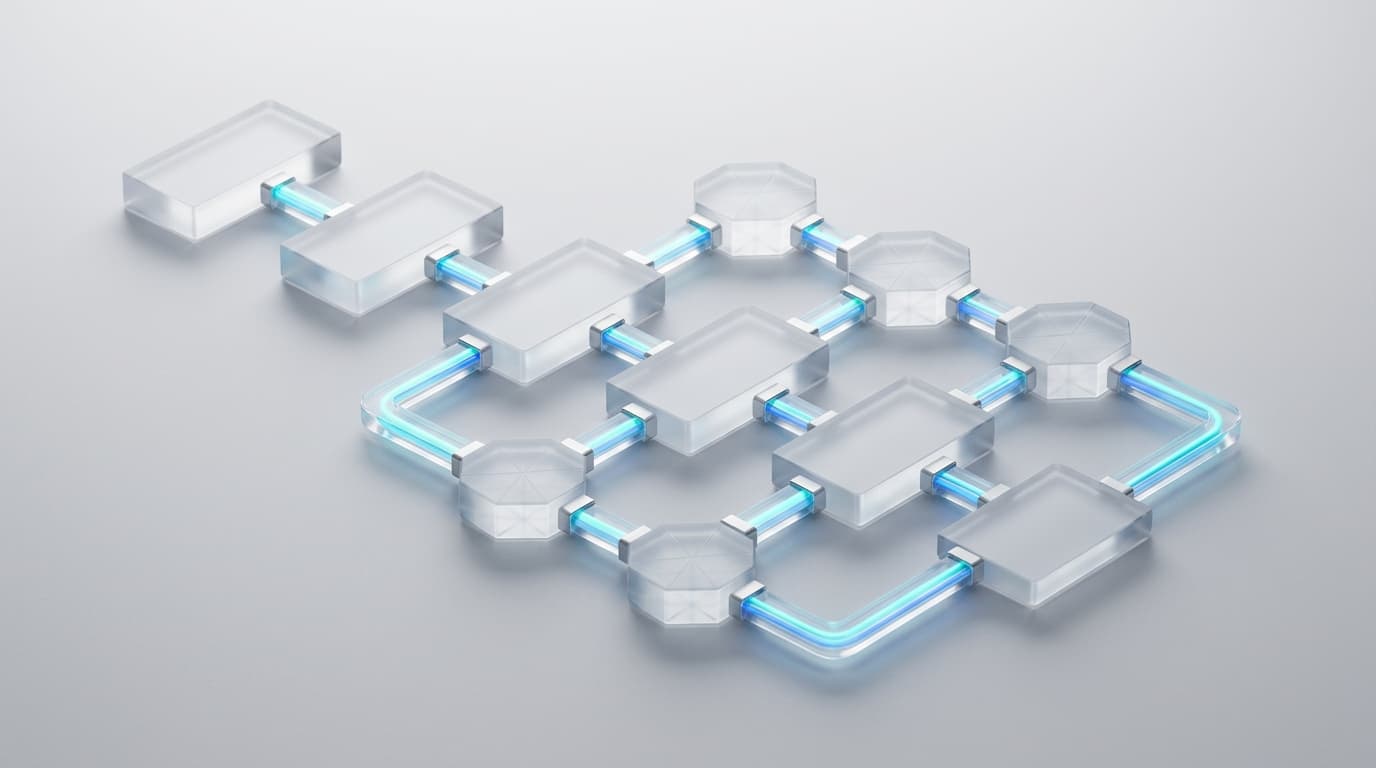
Most online roadmaps dump exhaustive lists of 50+ random Python libraries. This roadmap is different: it provides an architectural mental model structured around 5 concrete capability phases—designed specifically for experienced software engineers transitioning into production AI engineering.
The 5-Phase AI Engineer Mental Model
Phase 1: Foundation Models as Untrusted APIs & Typed Contracts
Before writing code, understand the fundamental mental shift: an LLM is an un-sandboxed, non-deterministic HTTP endpoint. Treat its output with the same defensive programming principles you apply to raw user input.
Core Milestones:
- 1Token Mechanics & Context Budgets: Understand BPE tokenization, Time-to-First-Token (TTFT), and token generation throughput.
- 2Deterministic Output Contracts: Never parse unstructured markdown text in backend services. Use OpenAI Structured Outputs or Pydantic validation.
- 3Prompt Design Patterns: Master Chain-of-Thought (CoT), few-shot framing, and negative constraints.
import { z } from "zod";
import OpenAI from "openai";

const client = new OpenAI();

// Milestone: Strict Typed API Contract
export const EntityExtractionSchema = z.object({
  entityName: z.string(),
  category: z.enum(["DATABASE", "INFRASTRUCTURE", "FRAMEWORK"]),
  confidenceScore: z.number().min(0).max(1),
  tags: z.array(z.string()).min(1),
});

export type EntityExtraction = z.infer<typeof EntityExtractionSchema>;
📖 Deep Dive Article: Advanced Prompt Engineering: Chain-of-Thought, ReAct, and Structured Output
Phase 2: Ingestion Pipelines, Hybrid Retrieval & Vector Databases
Naive cosine similarity vector lookups fail on technical nomenclature, error codes, and multi-hop queries. Production retrieval requires hybrid indexing combining dense semantic vectors with BM25 sparse keyword matching.
Core Milestones:
- 1Semantic Document Chunking: Moving past fixed-character chunking to boundary-aware semantic splitting.
- 2Hybrid Ingestion: Pairing dense embedding models (
text-embedding-3-large) with BM25 indices. - 3Cross-Encoder Re-Ranking: Trimming initial top-20 candidate retrieval pools down to the 3–5 highest-signal context chunks.
from sentence_transformers import CrossEncoder

# Milestone: Cross-Encoder Joint Query-Passage Scoring
reranker = CrossEncoder("cross-encoder/ms-marco-MiniLM-L-6-v2")

def rerank_retrieved_candidates(query: str, raw_passages: list[str], top_k: int = 3) -> list[str]:
    pairs = [[query, p] for p in raw_passages]
    scores = reranker.predict(pairs)
    ranked = [p for _, p in sorted(zip(scores, raw_passages), reverse=True)]
    return ranked[:top_k]
📖 Deep Dive Articles:
- Understanding Retrieval-Augmented Generation (RAG)
- High-Performance Vector Databases: Pinecone vs Qdrant vs Pgvector
- Next-Gen Agentic RAG: Hybrid Search, GraphRAG, and Self-Correction
Phase 3: Autonomous AI Agents, Stateful Graphs & MCP Protocol
An agent is more than an unconstrained prompt loop. It is a deterministic state machine equipped with typed tool execution boundaries, memory checkpoints, and human-in-the-loop authorization gates.
Core Milestones:
- 1Event-Driven Execution Loops: Designing deterministic state machines with hard iteration bounds.
- 2Cyclical Orchestration with LangGraph: Managing graph state persistence with durable MemorySaver checkpointers.
- 3Model Context Protocol (MCP): Connecting agents dynamically to external tools over standardized JSON-RPC transports.
- 4Specialized Multi-Agent Swarms: Dividing responsibilities across Supervisor, Worker, and QA nodes.
import { Annotation, StateGraph, END, START } from "@langchain/langgraph";

// Milestone: Stateful Graph State Definition
export const AgentGraphState = Annotation.Root({
  messages: Annotation<Array<{ role: string; content: string }>>({
    reducer: (curr, update) => curr.concat(update),
    default: () => [],
  }),
  currentStep: Annotation<string>({
    reducer: (_, update) => update,
    default: () => "init",
  }),
});
📖 Deep Dive Articles:
- How I Built an Autonomous AI Agent with Next.js 16
- Building Autonomous Production Agents with LangGraph and Anthropic MCP
- 5-Part Multi-Agent AI Framework Masterclass
Phase 4: Open-Weights Serving, Reasoning Models & MLOps
While proprietary frontier models (GPT-4o, Claude 3.5) are ideal for general reasoning, cost and privacy requirements often demand self-hosting open-weights models (DeepSeek-R1, Llama 3.3, Qwen 2.5).
Core Milestones:
- 1High-Throughput Inference with vLLM: Continuous batching, PagedAttention, and tensor parallelism.
- 2Reasoning Architectures (DeepSeek-R1 & GRPO): Multi-head Latent Attention (MLA) for KV-cache compression and critic-free reinforcement learning.
- 3Quantization & Edge Serving: Deploying AWQ/GGUF 4-bit and 8-bit quantized checkpoints.
from vllm import LLM, SamplingParams

# Milestone: High-Throughput Tensor-Parallel Serving
engine = LLM(
    model="deepseek-ai/DeepSeek-R1-Distill-Qwen-14B",
    tensor_parallel_size=1,
    gpu_memory_utilization=0.90,
    max_model_len=16384,
)
📖 Deep Dive Article: DeepSeek-R1 & GRPO: The Open-Weights Reasoning Architecture
Phase 5: Production Evals, Guardrails & Infrastructure SRE
Shipping to production requires continuous automated evaluation, rate-limiting circuit breakers, and OpenTelemetry observability.
Core Milestones:
- 1Automated LLM-as-a-Judge: Structured Pydantic scoring rubrics running inside GitHub Actions CI gates.
- 2Deterministic Safety Guardrails: Namespace boundaries, memory ceilings, and Slack approval webhooks.
- 3Autonomous Infrastructure Remediation: Self-healing controllers for Kubernetes pod crashes and GitOps drift.
from pydantic import BaseModel, Field

# Milestone: Structured Judge Rubric
class EvaluationMetric(BaseModel):
    factual_score: float = Field(ge=0.0, le=1.0)
    hallucination_detected: bool
    explanation: str
📖 Deep Dive Articles:
- LLM Evals in Production: Automated Benchmarking with LangSmith
- 7-Part Autonomous AI DevOps & Infrastructure Agents Series
Architecture Milestone Matrix
| Phase | Capability Level | Core Tooling | Primary Deliverable |
|---|---|---|---|
| Phase 1 | Foundation | TypeScript, Python, Zod, Pydantic | Typed Structured Output API Client |
| Phase 2 | Retrieval | LanceDB, Qdrant, Cross-Encoder | Production Hybrid RAG Pipeline |
| Phase 3 | Autonomy | LangGraph, Anthropic MCP, Redis | Stateful Multi-Agent Execution Graph |
| Phase 4 | Inference | vLLM, DeepSeek-R1, Ollama, PyTorch | Self-Hosted Open-Weights Cluster |
| Phase 5 | Production | LangSmith, OpenTelemetry, K8s, CI/CD | Automated CI Evaluation & Guardrail Gate |
Recommended Learning Sequence
To progress through this roadmap efficiently, follow our structured playlists:
- 1AI Engineering From Zero Playlist: Foundations, Prompting, and Vector Retrieval.
- 2Multi-Agent Framework Masterclass: 5-Part architectural deep dive into custom agent runtimes.
- 3Fullstack Web & AI Series: Next.js 16 App Router, React 19, and Generative UI Streaming.
- 4Autonomous AI DevOps Agents Series: Kubernetes self-healing, eBPF telemetry, and GitOps automation.